


Getting into the foster parenting game is not a well-trodden path to riches. Nor should it be. While we should pay foster parents fairly — meaning they should be given enough to both adequately care for the kids in their homes and to properly compensate them for the care work they perform — no one should expect to get rich from this job.
With that being said, there are several ways in which the key actors in the child welfare system — states, counties, agencies, foster parents, and even for-profit institutions — either enrich themselves off of foster children or otherwise siphon money away from them. The examples of this are too numerous to cite, so let me start with one that is both near and dear to my heart and that is likely to be criminally underestimated and tragically overlooked: foster parents pocketing state funds designated for foster children.
Let’s talk about clothing allowance. While I was in the system, I was entitled to receive an annual clothing allowance of a couple hundred bucks from the state of California. During my teenage years, this amount was subsidized by an additional $50 a month from the foster care agency that handled my case. I can imagine that in this regard, I was actually quite fortunate, as a lot of families in America likely don’t have the means to shell out $600 a year to update a teen’s wardrobe. But, unfortunately, at several of the homes I lived in, I didn’t see a dime of this money.

Taking this money from me wasn’t a very sophisticated scheme. It didn’t need to be. It all involved the same process: cash a check, submit a fraudulent receipt indicating that the money was spent on me, and furnish my wardrobe through some other, ideally cheaper, means. As far as I can tell, it worked to perfection because the plot was never detected by any of my social workers. Let me give you a play-by-play look into how this played out in one particular foster home.
I lived at this home for a few years, and I do not recall one time in which I received a clothing allowance, nor do I remember being taken to the store to shop. What I do remember was rifling through a cache of clothes my foster family kept in the house, clothes left behind by previous foster children. I remember my foster mother coming home with bags of clothes, donations from her coworkers and places she worked, much of which were previously worn by middle-aged men. Together, this constituted my wardrobe. While my social worker didn’t seem to notice the…vintage…collection of clothes I wore, the kids at school certainly noticed: some called me “Salvation Army” on account of my frayed and ill-fitting attire.
To get away with this, my foster parents would simply submit fake receipts. I saw it with my own eyes. One day, as we prepared for a visit with my social worker, my foster mother placed a stack of papers on the dining room table. Atop that stack was a receipt from Walmart. While my foster mother was in the other room, I snuck a look at it, and my long-time suspicions were confirmed. A bunch of items were listed, and not a single one of them were purchased for me. About an hour later, my social worker accepted this receipt without even looking at it. And just like that, $50 was funneled from the state into the pockets of my caregivers. This would play out at multiple placements, across multiple months (and sometimes, years), all without any accountability.
As I wrote about previously, one fundamental rule of being in the foster care system was you didn’t want to rock the boat. For the most part, you’d prefer to stick it out where you were — regardless of how bad it might be — rather than get sent somewhere potentially worse. So, for me, when I wasn’t receiving this money, I kept my mouth shut, afraid that reporting it would lead to reprisal. The one time I did report it was after-the-fact. It was right after one placement terminated, and literally on the drive to the next home, I told my social worker that my foster family pocketed every clothing allowance check I was entitled to receive during my time at their home. Fortunately, my social worker was able to recoup about $250 for me, which was no small feat.
This, importantly, wasn’t just a me thing. During my undergraduate research, I interviewed over three dozen former foster youth in California, and the vast majority of them told me that they too experienced the same issue. They spoke, unprompted, about the theft that went on, the money that was taken from them, and the not-so-elaborate means their caregivers used to maintain this practice. One person even told me that his foster mother came out and explicitly said that she wasn’t paid enough, and this allowance was used to supplement her income. Another spoke of how he was guilted by his caregivers into relinquishing these funds, as they spoke about the financially precarious position they were in (he was in care during the height of the Great Recession).
It is difficult to understand how widespread this issue might be, as there hasn’t been any study conducted on it, as far as I can tell. But given my own experiences and the experiences of the folks I have spoken with over the years — who were at different homes, at different times, and in different places across the state and country — this has to be occurring at a large scale. But as eye-opening as it might be, it isn’t even the most egregious example of foster children being used as proverbial cash cows.
Foster youth are disproportionately vulnerable to identity theft. The reason for this vulnerability is perhaps obvious: foster youth bounce around a ton, and along the way, countless people have access to their sensitive information. While we don’t have a firm grasp about how many children are impacted by this issue, there have been a few studies over the years that suggest a not-so-insignificant amount of children have had their identities stolen.
A 2013 audit, for example, conducted by the Office of the Inspector General at the Social Security Administration found that of the 96,000 children they examined, “over 4,900 (5 percent) had credit files that contained evidence that someone may have used their SSNs for credit or other purposes.” In 2014, a study in Los Angeles County found that approximately 8% of 16 and 17 year old foster kids “had fraudulent charges on their credit reports…most had thousands of dollars in accounts in their name.”
Fortunately, efforts are underway to protect foster children from having their identity stolen, with Congress having passed legislation that require states to “conduct annual credit checks for children aged 14 or older in foster care and to help these children interpret and resolve any inaccuracies identified in credit reports.” But nevertheless, as a result of their time in the system, there are folks out there who had their SSNs utilized before they could even articulate what a credit score even was.
Beyond these individual acts of fraud, however, whole states have gotten into the business of pilfering from foster youth. Children who are entitled to federal benefits — such as Social Security, veterans benefits, and other funds — have had their money unceremoniously stolen from them by the state, ostensibly to compensate the state for their care.
I think this is worth emphasizing again: states are funneling money away from foster children and into state coffers. Approximately 25,000 children in foster care are impacted by this practice, and up to $174 million a year is vulnerable to seizure by state governments (likely a conservative estimate, considering that not all states comply with reporting requirements). It is important to note that these children are entitled to these benefits as a result of their parents dying or because they have a disability. So not only do they experience one tragedy — the death of a parent, for example — they experience another one when they discover that they are having their pockets picked by the very system designed to care for them.
What makes this practice even more nefarious is that it is often done without the knowledge of the kid in question. An investigation conducted by NPR and the Marshall Project found the following:
“In at least 49 states and the District of Columbia, when young people go into foster care, child welfare agencies routinely look for which ones come with Social Security checks. Or, if the children are eligible, agencies sign them up for benefits. Then state agencies cash those checks — usually without telling the child or their family, the investigation found.”
Some states even hire for-profit companies to track down and acquire these benefits. In one particularly galling example, the state of Maryland contracted with a company called Maximus, which was tasked with achieving ‘maximum revenue impact’ by increasing the amount of children in the state’s foster care population “designated as disabled” from 2 percent to 20 percent so the state “could acquire up to $6 million of their disability benefits per year.”
In case this wasn’t stomach-churning enough, a 2013 assessment from the Maryland Department of Human Resources, conducted by Maximus, referred to foster children as a “revenue-generating mechanism.”
(If you want to learn more about this terrible practice, I highly recommend Dorothy Robert’s Torn Apart or Daniel Hatcher’s The Poverty Industry.)
While many states are curtailing this practice, my home state of California isn’t. Last year, Governor Newsom vetoed a bill that would have prevented “California counties from taking benefits, such as Social Security checks, from orphaned or disabled children in their custody, to pay for their foster care.” His reason why? The bill would “have cost too much,” given California’s nearly $30 billion budget shortfall (or higher, depending on who you ask). To put a fine point on this: children are having the benefits they are legally entitled to receive stripped from them because the state is experiencing a budget deficit.
This was but a brief overview of this issue. There was much I didn’t touch on, such as how foster youth are disproportionately more likely to be victims of sex trafficking, perhaps the most disgusting and heartbreaking form of using children as profit-generating assets. I could have also talked about how private equity firms are getting involved in the “troubled kids industry,” where they see vulnerable children as “money-making commodities.”
Ultimately, though, I hope the few examples discussed in this newsletter are sufficient enough to communicate the following: while some folks’ eyes fill with tears when they think about foster children, there are plenty of people whose eyes fill with dollar signs as they dream and scheme of ways to extract as much cash as they can from society’s most marginalized citizens.
On that somber note, I conclude this week’s newsletter. Thank you for subscribing, and I will see you again in a couple of weeks!
Current Read(s):
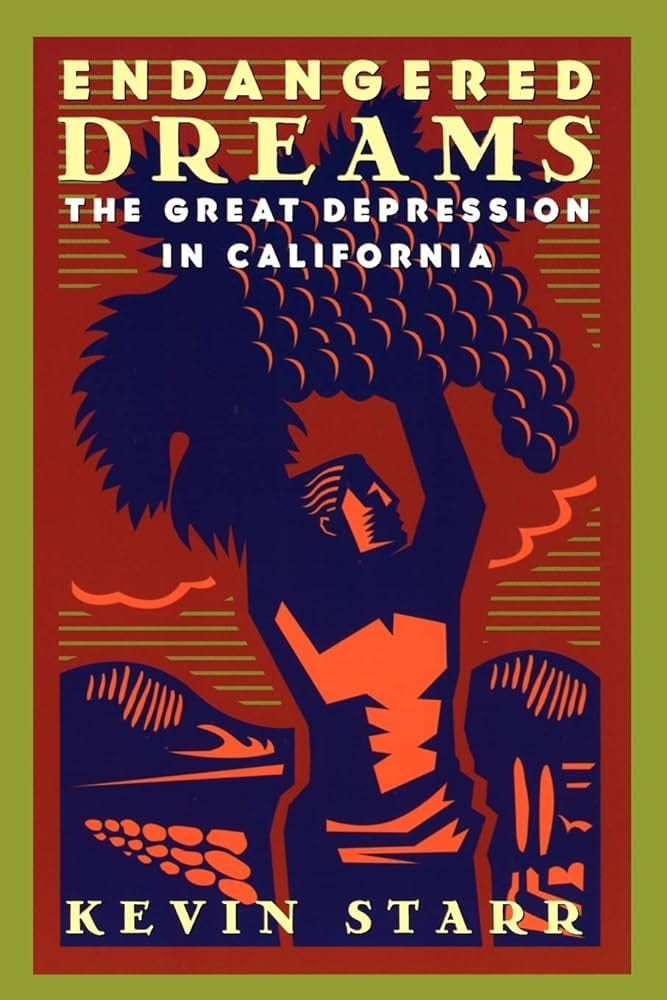
As a proud Californian, I always love to learn more about my state. As such, I have been working my way through Kevin Starr’s Americans and the Californian Dream series. This week, I’m reading Endangered Dreams: The Great Depression in California, which examines a pivotal time in the history of the state. It was during this period that some of the most enduring symbols of the state emerged, such as the Golden Gate Bridge. It was during this period that one of my favorite writers, John Steinbeck, penned his most lasting works, such as The Grapes of Wrath. And it was during this period where some of the most radical manifestations of labor movement came about, most of which would have a lasting, positive impact on the development of the state and the nation. I could keep going, but I hope you get the impression that I am very excited about this book, because I am indeed very excited about this book!
What’s going on in the world of child welfare?:
Foster Children Deprived of Benefits: How a Loophole Affects The Most Vulnerable (CBS News) — For folks who want to read more about how states are depriving children of there benefits, this article was published just yesterday.
Missouri House and Senate Advance Bill Stopping Seizing of Foster Kids’ Owed Benefits (KRPS) — In another relevant article, the Missouri legislature is aiming to end the practice of siphoning benefits away from foster children. According to the article, the state last year took $6.1 million from foster children, so ending this practice should have a sizable impact on foster kids in that state.
Foster Kids Miss Out on Sports and Music. A New California Plan Aims to Help Them Catch Up (CalMatters) — I remember how difficult it was to scrounge up enough money to buy new gear for all the sports I played during my time in care. As such, I applaud the Newsom administration for this proposal, which will hopefully ensure no kid has to experience this again.
When the Number of Bedrooms in a Home Keeps Parents From Getting Their Kids Back (ProPublica) — What a devastating and Kafkaesque read about how Georgia is preventing kids from reuniting with their families as a result of stringent housing requirements. In a state where foster children are often housed in hotels as a result of not having an adequate placement available to them, it seems asinine that children are kept from returning to their families due to some arbitrary room requirement.
Michigan’s Governor Signs Law to Help Foster Youth Earn Diplomas (NBC News) — Some children in certain type of placements in Michigan were taking substandard classes that were preventing them from graduating in time, and this law seeks to correct that.
HHS Secretary Becerra Announces Michigan as First State to Implement Kinship Care Rule (HHS) — In more Michigan news, the state is the first in the nation to implement a new kinship rule that will both make it easier for folks to become kin caregivers and to provide them with financial assistance equal to that of other foster care providers.
What Happened When This Italian Province Invested in Babies (NY Times) — In a world where this is a lot of handwringing about declining birthrates, this article shows how an Italian province might be forging a path forward by investing in families and strengthening communities.
For Families that Need the Most Help, Child Care Costs Are About to Drop (The 19th) — Child care continues to be unaffordable for many working families, but a new rule from the Biden administration might make life a bit easier for folks who need child care but struggle to afford it.