

Unheard, Unbelieved, Unfounded
What Happens When A Foster Child Experiences Maltreatment

Don’t have time to read the whole piece? Start here:
The Context: Across multiple states, investigations into abuse allegations against foster parents overwhelmingly conclude that the claims are “unfounded,” raising serious questions about whether the child welfare system is reliably identifying harm in the homes it oversees.
Data Point: In Illinois, roughly 9 in 10 abuse allegations against foster parents were ruled “unfounded.” In Oregon, the figure was over 88%.
The Challenge: Many foster youth stay silent because reporting maltreatment can bring retaliation or placement disruption. When they do report, their allegations are frequently deemed “unfounded.” Even when outsiders report maltreatment, the system still struggles to deliver meaningful accountability.
The Solution: Reduce reliance on foster care through prevention, and empower independent oversight bodies to routinely review abuse investigations so the system is no longer effectively policing itself.
At my first foster home, I was physically abused. Eventually, I worked up the courage to tell my social worker, and on the very day I did so, I was removed from the home. An investigation commenced; for months, I was asked hundreds of questions, spoke with multiple adults, and underwent a physical examination. Then one day, it stopped.
I waited weeks to hear what the investigation concluded; more specifically, I eagerly awaited justice. At long last, I thought, the foster family that had so harmed me would be held to account for all that they did. After a few months with no update, I was unable to wait any longer and asked my social worker what the investigation had yielded. The answer came plainly.
“They closed the investigation as unfounded,” he said. “There wasn’t enough evidence for them to move forward.”
The investigation was never mentioned again. Through the grapevine I heard that my previous foster family was still fostering children. The world moved on.
I never did. For years I fumed about it. This ‘unfounded’ finding implied that I lied about my abuse. Or, at the very least, it implied that my testimony wasn’t credible, or that my foster family’s version of events carried more weight than mine.
Even before this episode, I grasped instinctively what I couldn’t yet articulate: the foster care system incentivizes children to stay quiet about their maltreatment. This incident only reinforced that instinct.
My experience is so ludicrously widespread that I am confident in saying it is damn near universal. Perhaps that language is too strong, but I have spoken with hundreds (if not thousands) of former foster youth over the years, and so many of them could share a similar story.
They may not have been abused (though that was tragically all too common as well), but too many to count could tell you about the time they reported having their money stolen, or had meals withheld, or experienced some other transgression, only to be disbelieved. Or, worse yet, to have their allegation recorded and forgotten, absorbed into a stream of paperwork while nothing about their lives actually changed.
That’s just the folks who actually spoke up; many of them never even reported the maltreatment they experienced. Many learned — through the worst kind of trial-and-error — that you just can’t trust the system to deliver any accountability. I know this to be true because this was precisely my experience. Following that first incident, I stomached thousands of indignities — including brazen violations of the law by my caregivers — over my remaining years in care because I knew that raising my voice was more trouble than it was worth.
Today’s newsletter will explore all the above. Let’s begin.

A Troubling Pattern
Okay, you might be saying: ‘Look, it’s unfortunate that the investigation didn’t go the way you hoped, but that happens. No system is perfect, and sometimes things slip through the cracks.’ Tough to swallow, but what are you going to do? Nobody is going to lose sleep because one kid had his allegations dismissed.
The issue, however, is this doesn’t happen to just one kid. It happens to most of them. And by most of them, I mean the overwhelming majority of kids. Specifically, when foster children allege abuse or neglect by their foster parents, those allegations are overwhelmingly deemed unfounded.
Evidence abounds, but let’s start with Illinois. An analysis conducted by CBS2 News of internal DCFS records from 2016 through 2021 reviewed thousands of entries, line by line. The data covered more than 6,000 abuse and neglect allegations against approximately 3,200 foster parents. Nearly every single one of these allegations went exactly where mine went: nowhere. To be more exact: about nine in ten cases were closed by DCFS as “unfounded.”
It’s worse when you look at the nature of the allegations:
“The most common form of abuse allegations in the DCFS data involves physical harm - including bone fractures, head injuries, burns, torture, poison, noxious substances, cuts, bruises, welts, abrasion, oral injuries, human bites, sprains, dislocations, tying, and close confinement. A staggering number - 91% of these incidents - were unfounded by DCFS investigators.”
A strikingly similar dynamic can be observed over 2,000 miles away, in Oregon. According to a review of Oregon DHS investigation data by FOX 12 Investigates, the state opened 2,415 foster parent abuse and neglect investigations between 2019 and 2023. Over 88% were ruled ‘unfounded,’ while only about 12% were substantiated.
In an article describing the above findings, former foster youth in Oregon shared devastating stories about how they tried and failed to get someone to pay attention to their concerns. One tragic example:
Hannah Decker, 26, shared a story of living in an unsanitary foster home as a teenager, struggling to get her caseworker to listen.
“I called my caseworker and left a voicemail because he never answered his phone and reported that the house was full of dog and cat feces,” she said. “They were hoarders, it was not a clean environment at all whatsoever. And I tried to report to him how bad it was getting, and he never did anything about it.”
Forgive me if I sound like a skeptic but you mean to tell me that thousands of kids across two different states are alleging that their foster parents are abusing them, and the system is absolving virtually every single one of those foster parents?
Think, for just one second, what it means to believe that the above outcomes are accurate. It means accepting that the system — known to be deeply flawed across so many dimensions — conducts investigations with such flawless rigor that it reliably determines that roughly 90% of children’s allegations are unfounded.
As a consequence of believing the above, you must also believe something else: that thousands of children, across multiple states and years, either outright fabricated harm, exaggerated it, or simply failed en masse to provide “sufficient” proof. That they all came up short in the exact same direction. The implication of holding these two beliefs is that the foster care system must be keeping children so extraordinarily safe that abuse within it is vanishingly rare.
A far more plausible explanation is this: we built a system that, whether by design or default, treats the child as the least credible person in any room, and we designed an investigative process that somehow exonerates the licensed adult of any wrongdoing in nine out of ten cases.
Now, to be fair, I don’t know what an appropriate ratio would be. There are genuine cases where maltreatment simply did not occur, where a misunderstanding produced a report, or where an allegation was false. That is an unavoidable reality of any investigative process.
But even accepting the above, it strains credulity that nine in ten allegations of abuse lack evidence. And to be clear: we just looked at two states. There have been some studies that suggest the rates of substantiated abuse while in the system actually range from 0.27% to 2% annually. Maybe I’m wrong and it truly is the case that 90% of the kids reporting abuse are mistaken or malicious. But I have doubts.
Let me sharpen my point by isolating what’s really being claimed. The Illinois and Oregon numbers ask us to accept something remarkable: that the system is almost always right and children are almost always wrong. If nearly 90% of allegations are deemed unfounded, then either abuse in foster care is genuinely rare, or the investigatory process is simply not very good at detecting it (for whatever reason). I suspect the latter, but let’s test my suspicions by changing the variable: what happens when the allegations come not from foster youth, but from teachers, doctors, daycare workers, neighbors, and other adults?
A Damning Indictment on the Foster Care System
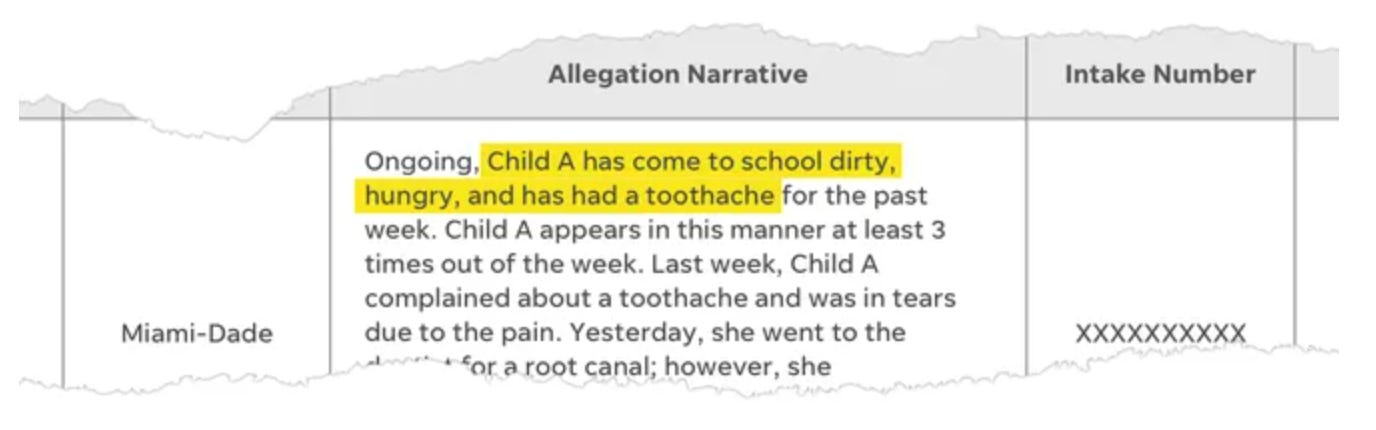
A 2020 USA TODAY investigation reviewed a large cache of Florida child welfare records and uncovered allegation after allegation describing what children in state care were said to endure. I won’t editorialize too much because the material is so disturbing, so here are the key points from the investigation:
A hidden archive of alleged abuse: USA TODAY reviewed thousands of records covering a five-year period involving complaints about the treatment of foster children, yet ‘none of these cases would have been counted’ in what the state publicly reports each year about child maltreatment. Why? Because of a bureaucratic sleight of hand whereby the state categorizes these accusations as ‘referrals’ that do not meet its definition of serious harm.
The allegations were graphic: These accusations describe conduct that is difficult to read:
Foster parents and group homes were accused of “hitting children with hands, belts and household items.”
Other allegations involved denying children medical care and sending them to school “dirty, hungry and dressed in ill-fitting clothes.”
The records described “empty pantries and padlocked refrigerators,” children in “rodent-ridden homes,” and kids eating “cereal crawling with ants.”
One caller described a girl whose “face and body [were] covered in sores, dripping fluid down her arms that stuck to her clothes.”
Children were physically abused: DCF policy “expressly forbids cruel and unusual disciplinary methods as well as corporal punishment.” Even so, USA TODAY found “nearly 900” records describing some form of physical abuse or corporal punishment, including spanking, hitting, slapping, pinching, or shaking.”
Children were reportedly “spanked for wetting the bed, crying too loud or too long, moving too fast or too slow, for making poor grades, losing insignificant items or forgetting trivial information.
Cruel and unusual punishments: Beyond the sheer frequency of corporal punishment, some of the examples in the article cross over into something more sadistic:
One woman was reportedly accused of forcing foster children to stay in their room “facing the wall all day” and slapping them if they leaned on it for support.
One of the children said the woman made him “eat a graded school paper” and called him a failure.
A child had marks on his legs that the foster mother reportedly claimed were “bug bites,” while the children in the house said they were burns.
Widespread and flagrant child neglect: Many children enter foster care as result of neglect, and this analysis found that many continued to experience it in care:
USA TODAY reports that more than 800 foster care referrals featured some form of neglect.
One sister and brother said they were not allowed to bathe on weekends because the foster mother said the water bill was too high.
One caregiver allegedly locked the refrigerator; when told to remove the lock, she reportedly replaced it with a bell.
Another complaint alleged that a foster mother would not feed her children at home because they had “already ate” at school.
An astonishing lack of accountability: These accusations are disturbing. Just as disturbing, however, is the lack of accountability that appears to have followed:
Over five years, the number of referrals rose by roughly 54%, from fewer than 700 complaints to more than 1,000. Over that same period, DCF revoked or refused to renew only 29 caregivers’ licenses.
USA TODAY was also provided with just 58 corrective action plans, suggesting that many cases ended not with the closure of a home, but with additional training, monitoring, or other limited corrective measures.
The most appalling example in the article concerns sexual abuse. In one case, a 5-year-old being watched by a foster mother was reportedly sexually molested. Two months later, a former foster child alleged that the family’s adopted son had raped him “for years.”
And yet, as the article puts it with chilling simplicity, “DCF did not revoke the foster license this time either.” Instead, officials implemented a corrective action plan:
“The couple could have just one young foster child. Their adopted son could still be around other children as long as he was carefully supervised.”
Let me explicitly link the findings from the three states: the claim that 90% of allegations of abuse by foster parents are unsubstantiated becomes much harder to take seriously once you see how much serious harm the system is willing to minimize in another context.
I know I only looked at three states, and some might reasonably claim that I am cherrypicking: choosing the worst examples and brandishing them as being representative of the system overall. Maybe these three states are just uniquely bad, and I’d be happy to be furnished with evidence that contradicts the argument I laid out here. I’ll just say that I’ve personally heard stories from foster youth all over the country — from Alaska to Maine — that suggest the patterns described here are far from isolated.
But even if one were to say that three states and fewer than 15,000 cases spread over multiple years amount to only a fragment of the national picture, I would still wager that abuse, neglect, and maltreatment in foster care occur at rates significantly higher than the official numbers suggest. I know this because I didn’t report most of the maltreatment I experienced, and I know this because I spoke with so many who said the same.
A Mountain of Hidden Child Maltreatment
Imagine you’re 9 years old. You have been placed in a stranger’s home. Your mother is incarcerated and you have been separated from your siblings. You know next to nothing about what to expect, only that you’re scared.
Now imagine your caregiver — your foster parent — harms you in some way. Imagine, say, they hit you. I won’t get graphic here, but let’s say they hit you so hard that it can’t be chalked up to what some might call ‘good old-fashioned American discipline.’
Would you tell your caseworker? Let me paint the scene for you: you are sitting in the living room of the perpetrator’s home while your caseworker, during a routine visit, asks you if everything is okay. In the other room, perhaps even within earshot of your conversation, is your foster parent. Also: this might be the fifth or sixth social worker you’ve had, and this might only be the second time you’ve met this particular one. In that setting and with that context, would you tell your caseworker that you are being abused? You’d likely be thinking to yourself:
“If I speak up and my foster parent overhears, what if they hit me harder?”
“What if my social worker doesn’t believe me and I get into trouble for lying?”
“What if my social worker tells my foster parent, and when they leave, I get beat again?”
Ask yourself honestly: would you risk reporting your caregiver? Given the circumstances described above, I suspect most of you wouldn’t. But perhaps that feels like too hypothetical a scenario. If so, let me offer a few concrete examples from my award-winning undergraduate thesis, where I interviewed 37 former foster youth in California.
Each interviewee had spent time in California’s child welfare system as a teenager, and the vast majority described trying to avoid placement disruption while in care. One of the main ways they did so was by suffering in silence: 35 of the 37 interviewees said they kept quiet about the maltreatment they experienced. One quote captures this strategy well:
"I was supposed to get $50 a month, but [foster mother] was taking that and pocketing it...But what the f*** was I gonna do? Couldn't say anything about it because if I did, I was for sure gonna move. New school, new friends, all that. So I didn't say s***, because I wasn't about to lose my friends for a couple hundred dollars."
Virtually all the teenagers I spoke to were worried that terminating the placement would entail them switching schools and thus losing all their friends. Others were concerned about being sent somewhere worse — hence the title of my thesis, ‘The Evil You Know’ — and dealing with much worse than what they were currently enduring. As such, many of them suffered in silence.
I wrote about this before, but when I was in care, the threat of being placed in a group home constantly hung over my head. My social workers and caregivers would tell me explicitly: “You better not screw this placement up, not a ton of families want to take teenage boys.”
With that context, the calculus was simple: stay quiet or risk losing everything. This is the brutal math that so many foster youth face every day, and it all adds up to a whole lot of harm that never gets reported, investigated, or counted. This finding — and my own personal experience — is echoed by several other studies using a range of different methodologies.
So, effectively, we see three separate-yet-interrelated issues:
Foster youth largely aren’t reporting the maltreatment they experience.
When they do report maltreatment, it largely determined to be unfounded.
Even when outsiders report maltreatment, meaningful accountability rarely follows.
No matter which way you cut it, there is a problem and it needs to be fixed.
Protecting Foster Children
I cut an unbelievable amount from my initial draft, as the newsletter format only allows so much text before they start cutting you off. That said, I hope what remains is both compelling and convincing, as this is a crisis that strikes at the heart of what the child welfare system purports to be: a safe and stable option for children who cannot remain with their family.
Addressing this crisis will require more than tinkering at the margins. Prevention matters: with fewer foster children means fewer foster parents, which means we can be more selective about who is entrusted with caring for our country’s most vulnerable kids. Fewer foster youth also means smaller caseloads, which would give social workers the time and bandwidth to actually monitor placements, follow up on concerns, and intervene before harm escalates.
We could also shift who actually conducts these investigations. In most states, the same child welfare agency that licenses foster homes and places children in them is also responsible for investigating allegations of abuse within those homes. Some states already have independent oversight mechanisms — inspectors general, ombuds offices, child advocates, etc. — and those entities should be empowered to lead (or at minimum independently review) these investigations on a routine basis, not just when scandals erupt. Put simply: the system should not be policing itself
We can also take what is common knowledge among former foster youth — that reporting maltreatment is often a fool’s errand — and do something about it. We can show them that they won’t be ignored or punished if they speak up. I have ideas on how to exactly do that, which I will discuss in a future newsletter (but email me if you want the spoiler).
Thank God for the intrepid investigative reporters who conducted the analyses cited in this newsletter, but we shouldn’t have to rely on media organizations to do this work. We should treat every child in foster care as if they were our own — and in a way they are — and demand a system that actually protects them.
Thank you for reading.
Current read(s):
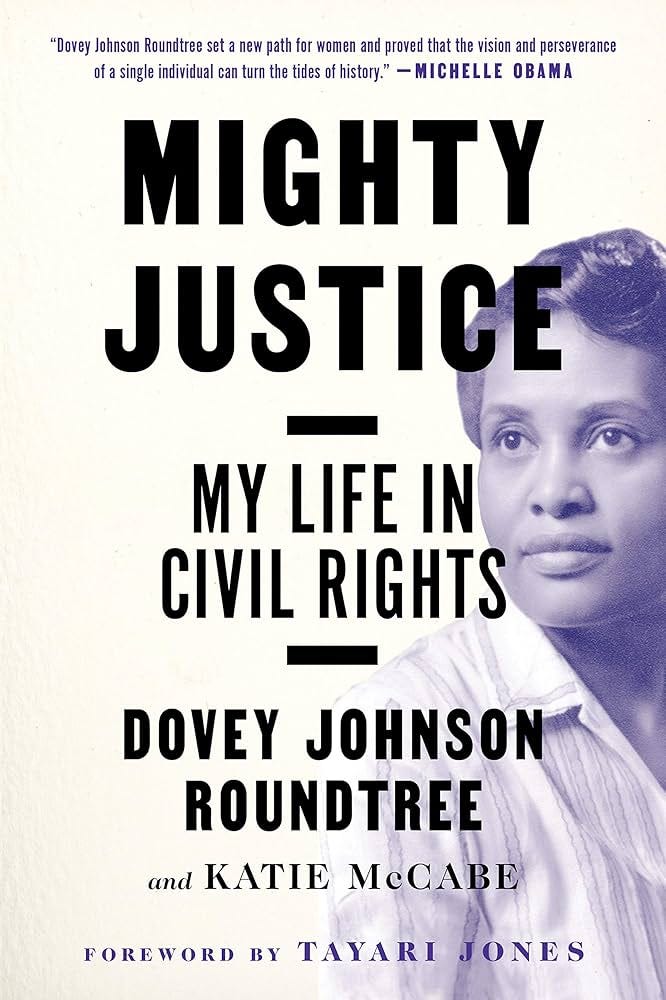
This week, I am reading Might Justice: My Life in Civil Rights by Dovey Johnson Roundtree, a pioneering civil rights attorney, Army veteran, and ordained minister. She’s one of the civil rights movement’s unsung heroes, helping win a landmark case challenging segregation in interstate bus travel in 1955. While that might seem like ancient history to some, the fact that she passed away in 2018 (at 104!!) shows just how recent and relevant that period remains.
What’s going on in the world of child welfare:
How California Reduced Foster Care Without Risking Kids (The Sacramento Bee)
Senators Vote for Massive Overhaul of WV Foster Care by Shifting Children’s Cases to Private Company (West Virginia Watch)
“Kanaiyah’s Law” Aims to Bolster Foster Care Regulations in Maryland (CBS News)
Fight to Reform WA’s ‘Stunning’ Child Welfare Crisis Stalls in Legislature (FOX13 Seattle)